Have You Ever Wondered…Why “We Talked About It” Isn’t Communication?
ICU communication isn’t a vibe. It’s a system families can feel. Using ARMOR as a framework, this Tuesday Teaching Edition explains how huddles, daily goals, and structured rounds can create clarity, safety, and trust.
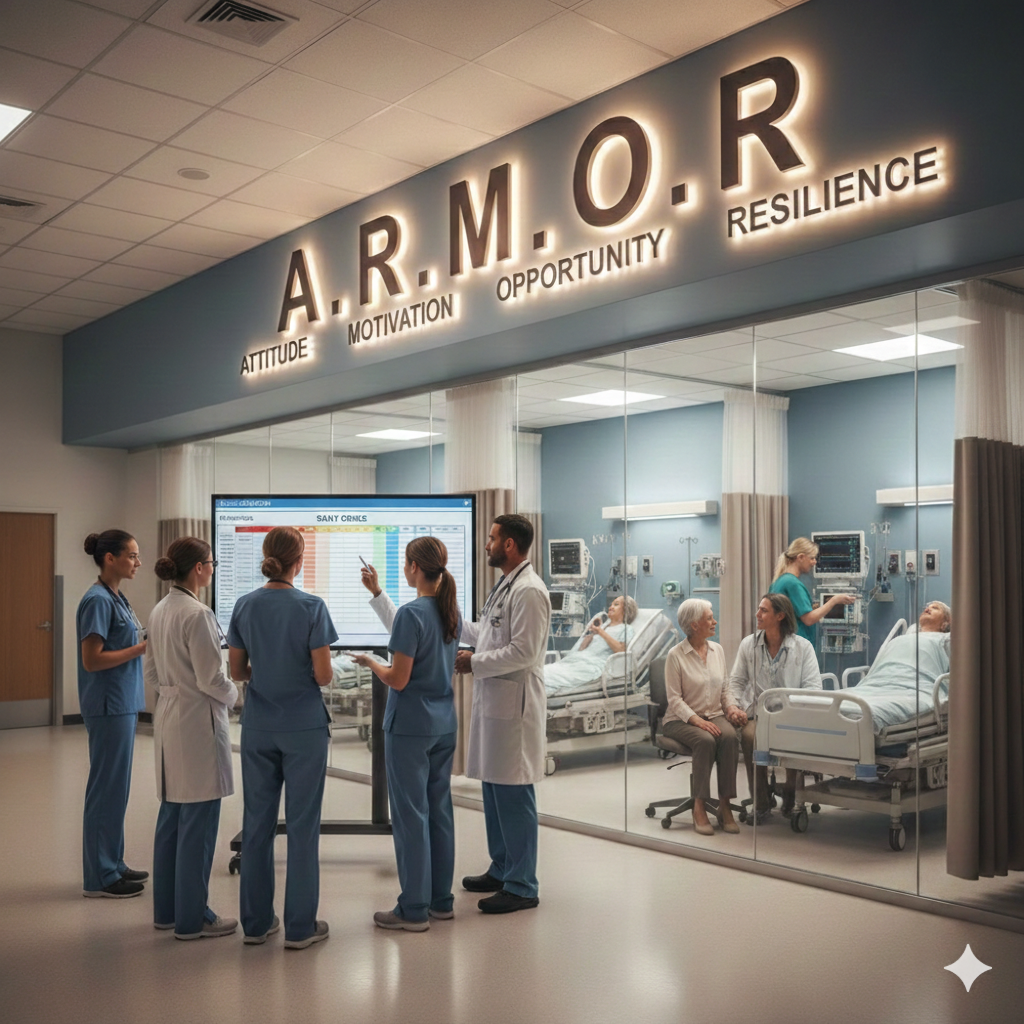
If you’re reading this as a family member, here’s what I want you to know: you deserve a team that speaks with clarity and respect, especially when you are scared.
Have You Ever Wondered… (Teaching Edition)
This afternoon I texted a buddy:
“Hey man, I’m at the gym, and it’s packed.”
He wrote back:
“Oh man, I hate it when it’s like that. Machines are full. You gotta wait.”
I almost replied too fast. I felt my own defensiveness rise. Then I caught myself.
What was actually happening wasn’t a “him” problem. It was a tone problem on a screen. A meaning problem. Mine.
I meant: the place is alive.
He heard: the place is inconvenient.
Same sentence. Two realities.
I’ve been on both sides of that text a thousand times. Sometimes I’ve meant energy. Sometimes I’ve meant annoyance. Today I meant energy, and I didn’t send enough context to carry it.
He followed up right away:
“My bad. I get it. Good energy.”
That tiny exchange is the ICU in miniature.
In the ICU, humans do high-stakes work while trying to interpret each other’s meaning at speed. When the meaning doesn’t land, the cost isn’t just annoyance. It can be delay, confusion, missed details, or harm.
Communication failures are a known driver of medical error and patient harm. That’s not drama. It’s the reality of complex systems.
So here’s where my head went as I walked on the gym treadmill on a polar vortex afternoon, iced roads, kids home from school, the world compressed, and yet, the gym more packed than ever.
People weren’t showing up because it’s easy.
They’re showing up because the place carries them. It has a system.
There’s a guy here I see at 5:30 a.m. over and over. Same discipline. Same nod. No speeches. Just presence. Don’t even know his name.
And the gym is called ARMOR.
Above the mirrored walls plastered around the gym’s interior, like crown molding made of words, stickered letters repeat:
A = Attitude
R = Respect
M = Motivation
O = Opportunity
R = Resilience
I realized this is what families feel when they walk into an ICU.
Not the awards in the lobby.
Not the plaque outside the unit.
They feel the ARMOR.
They feel: Are these people steady?
Do they respect each other?
Do they look like a team?
Do they know the plan?
Do they speak in a way that makes me feel safe?
So let’s use ARMOR as a teaching framework for ICU communication that actually works, and that families can understand.
Attitude: the tone that decides whether truth can be spoken
Attitude isn’t “be positive.”
Attitude is whether the environment allows people to tell the truth early.
If a nurse fears being snapped at, they will hesitate.
If a resident fears being shamed, they will soften the message.
If a family feels dismissed, they will stop asking questions.
This matters because the ICU runs on early signals.
Small changes noticed early are how we prevent disasters later.
This is why brief huddles exist.
A huddle is not a meeting. It’s a short stand-up reset: What are we worried about today? What are we watching? Who needs help?
AHRQ’s patient safety work describes huddles as a practical way for teams to share information, proactively flag safety concerns, and hardwire safety into the daily routine.
Respect: respect is operational, not optional, not sentimental
Respect in the ICU is not “being nice.”
It’s how the work is structured. And it’s not optional.
Respect means the bedside nurse’s read of the room is treated like a primary data stream, not an afterthought.
It also means families are not “visitors” to be managed.
They are the patient’s memory, values, and context.
Think about that for a second. I’m still learning how to do this better.
This is where structured interdisciplinary bedside rounds matter.
There’s evidence in ICU settings that patient-centered, structured, interdisciplinary bedside rounds can improve rounding efficiency and provider satisfaction, and can support consistent teaching, without negatively impacting patient or family perception.
That last finding matters for families:
Structure doesn’t mean coldness.
Structure can mean clarity.
Motivation: meaning is what sustains people when the work is heavy
In the gym, motivation isn’t a poster.
It’s the quiet decision to show up anyway.
In the ICU, motivation is fragile. People are tired. They’re carrying grief. They’ve seen too much.
What sustains them is meaning.
And meaning is often transmitted through small moments of teamwork that actually feel human.
This is why communication systems shouldn’t just move information.
They should protect dignity.
If your unit’s communication style strips people down, you will burn through good clinicians and families will feel the chill.
If your unit’s communication style honors people, you build a kind of warmth that spreads.
It’s taken me years to grow into my approach here.
Opportunity: turning “talking” into shared clarity
Opportunity in the ICU is the moment you stop letting the plan exist in three different heads.
This is where the evidence gets refreshingly practical.
One of the classic ICU communication studies tested a simple tool: a daily goals form used on rounds.
The point wasn’t paperwork.
The point was alignment.
When teams used an explicit daily goals sheet, the percent of residents and nurses who understood the goals of care for the day improved significantly.
That’s the win: shared understanding.
It’s the same principle as informed consent: shared understanding, in plain language.
For families, this is what it looks like in real life:
When you ask, “What’s the plan today?” you get one clear answer, not three competing versions.
Resilience: resilience is design, not toughness
Resilience isn’t “we’re strong.”
Resilience is “the system holds even when we’re depleted.”
A daily safety huddle is one example of resilience by design.
In a pediatric ICU improvement project, a daily safety huddle approach was used to enhance teamwork communication and respond more effectively to safety issues raised by frontline staff.
When you zoom out beyond any single unit, a large scoping review of huddles across healthcare found that huddles were commonly used to improve communication and coordination, and many studies reported positive impacts on team processes like efficiency, communication, and situational awareness.
Do huddles fix everything? No.
But they are one of the few interventions that are short, repeatable, and capable of scaling across a big unit.
Which brings us back to the hard truth about large ICUs:
If you have five nurses, you can lead by proximity.
If you have twenty, you can still “walk it” and patch it with presence.
If you have hundreds across multiple floors and shifts, you need machines.
Not cold machines.
Human machines.
Rituals that produce clarity and safety even on the worst day of the month.
And here’s the part I keep thinking about, for families and clinicians:
Awards don’t guarantee ARMOR.
Some places have plaques and still feel tense, sharp, fragmented.
Other places don’t have the plaque and yet the team feels steady, respectful, and aligned.
The difference usually isn’t intelligence.
It’s whether communication has been designed.
DOCTOR’S ORDER
Don’t chase “better communication” as a vibe.
Build it as a practice.
Make it brief. Make it repeatable. Make it kind.
Let your ICU feel like ARMOR to the people who are terrified inside it.
REFERENCES
1. Agency for Healthcare Research and Quality (AHRQ). PSNet Primer: Improving patient safety and team communication through daily huddles.
2. Pronovost PJ, et al. Improving communication in the ICU using daily goals. Journal of Critical Care. 2003;18(2):71-75.
3. Cao V, et al. Patient-centered structured interdisciplinary bedside rounds in the medical ICU. Critical Care Medicine. 2018;46(1):85-92.
4. Aldawood F, et al. Enhancing teamwork communication and patient safety responsiveness in a paediatric intensive care unit using the daily safety huddle tool. BMJ Open Quality. 2020;9(1):e000753.
5. Pimentel CB, et al. Huddles and their effectiveness at the frontlines of clinical care: a scoping review. Journal of Patient Safety. 2021;17(8):e1407-e1418.