INK+OXYGEN #2: Showing Up
A Christmas morning at the kitchen table—drawing with my kids, thinking about breathing rhythms in the ICU, and learning why showing up matters more than being productive.
Do what nature demands. Get right to it if it is in your power.
And don’t look around to see if anyone will notice.
— Marcus Aurelius
Lately, I’ve been wondering: do we really need to be productive every day?
That question has been sitting with me not as philosophy. But more like a
small, honest sentence that shows up when you’re running on fumes and still
expect yourself to be “on.”
Christmas morning today sharpened it.
My daughter woke up yelling “SANTA CAME!” like the house itself needed to
wake up and witness it. Her awe did something grounding to me. In that sleepy,
coffee-less hour, as wrapping paper spread across the floor, I found myself
settling in.
New markers were everywhere—bright, uncapped, rolling across the kitchen
table like they’d been waiting all year to be used. I don’t usually draw at
the table… unless I’m drawing with my kids.
Then it’s the only place that makes sense.
They draw fast. No hesitation. No warming up. No checking whether what
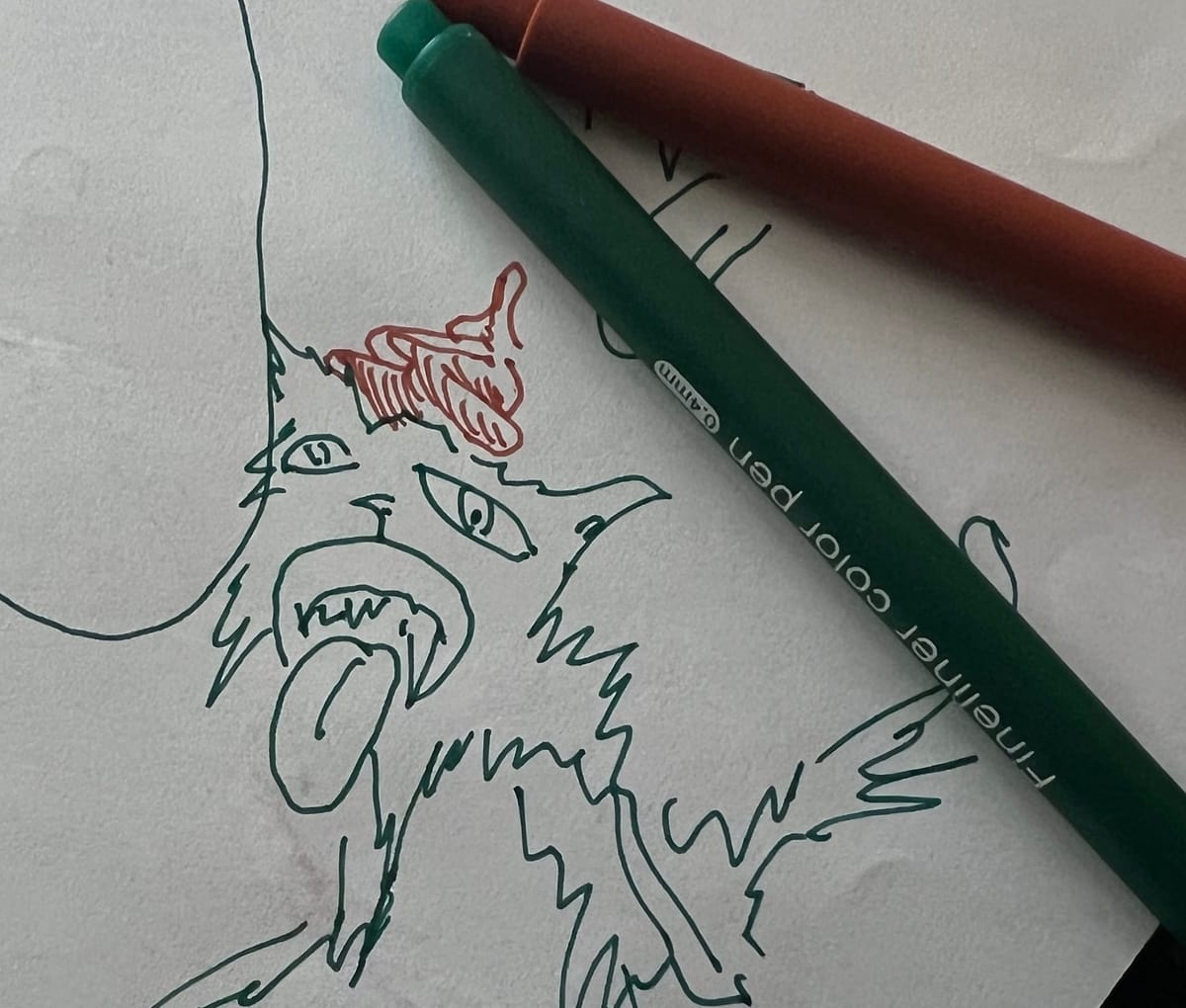
they’re making is “good.” Today, I was asked to draw an ugly cat.
Then they’re on to the next thing: an ugly cat with poop on it.
I draw slower.
At first that bothered me. I felt behind, like I was interrupting their flow
instead of joining it. Then I realized something important: they weren’t
waiting for me. They didn’t need me to keep up. They just needed me there.
That’s been one of the quiet gifts of drawing with kids. It isn’t about
teaching them how to draw. It’s about remembering how to begin.
Halfway through this year, I picked up a hardback copy of Ryan Holiday’s
The Daily Dad. Each page is a single calendar day—no year so it can be read
annually—just a small reminder meant to meet you wherever you are.
I don’t read it every day. I read it in streaks—three mornings in a row,
then nothing for a week, then back again. I mark the pages that stay with me.
That rhythm feels more honest now. More doable.
The lines that stay with me are rarely complicated. They’re reminders more
than instructions: be present. Don’t outsource your attention. You don’t
get this time back.
Simple ideas. Easy to agree with. Hard to live.
Especially when I’m tired.
My days start early now. Earlier than they used to. Earlier this year I had a
real run of morning workouts—long enough that I told friends I’d joined the
“5 a.m. club.” One of them promptly reminded me that 5 a.m. doesn’t exist.
Still, I’ve been getting up before the house wakes, pulling on gym clothes in
the dark, and heading out for a short workout. Nothing heroic.
Just enough to move. Enough to sweat. Enough to fall back into a rhythm that
my body—and my breathing—can sustain.
And there’s a pulmonary lesson hiding in that routine.
Breathing is rhythmic. It’s not something you “crush.” You don’t win at it by
doing more. You win by finding a cadence you can sustain. Too fast and you
panic. Too slow and you starve. Too rigid and you fatigue.
The lungs are unforgiving teachers. They demand balance. They demand
attention. They punish ego quickly.
I think that’s part of why a major ICU paper from this month took my
attention.
A large international randomized trial in JAMA compared INTELLiVENT
adaptive support ventilation (ASV), an automated closed-loop system, with
conventional protocolized ventilation.

The question: if we put the ventilator more on “autopilot”—a closed-loop
system that continuously adjusts settings based on real-time physiologic
feedback—do patients get off the ventilator sooner?
The answer, in the outcome that matters most, was no.
In the trial above (ACTiVE), early automated closed-loop ventilation did not
increase ventilator-free days by day 28 compared with protocolized
conventional ventilation. Median ventilator-free days were essentially the
same: 16.7 vs 16.3.
But it wasn’t a “nothing happened” study.
When you look inside the details, the automated approach was associated with
fewer severe episodes of hypoxemia and hypercapnia, and signals of less rescue
therapy use (things like prone positioning), even if not all those secondary
findings stayed statistically firm after adjustments.
The way I see it, better control didn’t automatically convert into fewer days
on the ventilator for a big, mixed ICU population. Liberation from the vent is
not just settings. It’s sedation, delirium, weakness, infection,
hemodynamics,timing, and the daily vigilance of a physician and nursing team
who notices the small turn in the patient’s face before the monitor does.
The most important parts of critical care still aren’t fully automatable.
People don’t heal on schedule. Patients don’t read the textbook, as the old
medical school adage goes. And the bedside work—the quiet, repetitive,
unglamorous watching—is still sacred.
If you’ve spent any time in an ICU, you know what I mean when I say there are
nights when nurses and respiratory therapists are the closest thing our
patients have to angels.
Why?
Because they keep the rhythm when someone else can’t.
And that’s where the paper met the drawings with my kids on the kitchen
table.
Because I’m trying to build a life where I stop worshiping intensity.
This year, during Inktober—a month-long drawing challenge where artists
commit to making one ink drawing a day—I showed up for 19 of the 31 prompts.
Old me would’ve framed that as failure. I didn’t finish the whole thing. I
fell short. I broke the streak.
New me sees something else: I showed up for nineteen days. Nineteen days
where I made a mark instead of waiting for motivation. Nineteen days where
drawing was part of the rhythm instead of an event that required the right
conditions.
The difference matters, I think. Not just as a dad or as a creator, but as a
human.
Drawing with kids helped that shift more than any motivational YouTube video
ever could. Kids don’t care if you miss a day. They don’t care if yesterday’s
drawing was better. They only care about whether you’ll draw now.
And medicine—quietly, relentlessly—teaches the same thing.
You don’t get credit for the shift you crushed last week if you’re not
present today. You don’t get to bank resilience. You don’t get to live off
past wins. You show up now, or you don’t.
What I’m learning, slowly, is that rhythm beats intensity.
The early workouts don’t change me because they’re extreme. They change me
because they’re repeatable. Drawing with my kids doesn’t make me a better
artist because the drawings are “good.” It makes me better because I keep
starting—again, and again, and again—under imperfect conditions, in the
middle of real life.
Even Stoicism, stripped of quotes and marble statues, is mostly about this:
return to what matters. accept the limits. don’t dramatize the miss.
As a buddy says:
Keep it continue.
That’s oxygen thinking.
So this is what I’m trying right now.
I’m not chasing perfect streaks. (Only perfect steaks 🥩.) I’m building a
rhythm that can survive real life. Some days that means a workout and a
sketch and quiet. Some days it means chaos and crayons and five crooked
lines before the door closes behind me.
Both count.
Because the goal isn’t to finish everything.
The goal is to keep breathing, keep drawing, and stay awake inside the life
that’s already happening.
And maybe that’s the quiet gift of today—
The awe in a child’s voice.
The mess on the floor.
The crooked drawings.
The imperfect rhythm that still holds.
If you’re reading this tired, distracted, behind on whatever you told
yourself you’d fix this year—you’re not late.
You’re here.
Merry Christmas, friends.
Keep breathing. Keep beginning.
Originally published on Substack. This version lives here as part of the BOKA archive.