The Quiet Weight We Carry
INK+OXYGEN by Dr. Boka. A reflection on the quiet weight of responsibility in medicine, leadership, and daily life.
INK + OXYGEN: Chapter 3
This essay is published on my substack at BokaMD.substack.com.
Some of the heaviest weight we carry never announces itself. It doesn’t arrive as an emergency. It doesn’t come as a fever. It doesn’t show up as an email. It doesn’t ring the doorbell.
It just shows up.
It shows up in the morning on awakening as stiffness in your shoulders, pressure at the base of your neck, a quiet heaviness in the upper back. You can feel it before you can name it. And you already know the only way out is through the day. You have to move it.
You have to foam roll it. You have to stretch into it. You have to pause and breathe, for at least for a minute.
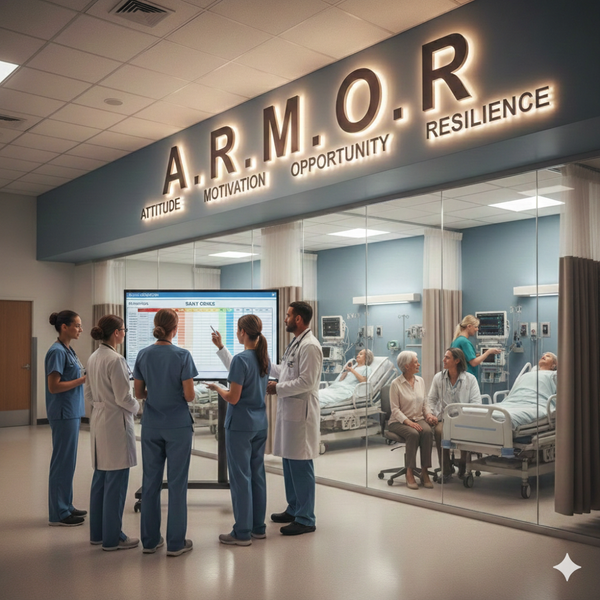
We feel this every day as parents, as leaders, as students, as physicians and clinicians, and sometimes, even as patients. In intensive care medicine, this weight often shows up during the calm.
Quiet rounding. A chart review. That moment before you knock on the patient’s door.
Before you meet a family for the first time and some part of you already knows this may be their last time with the person they love.
Things feel steady. The monitors with their infinite loops of quiet atrial and ventricular tracings. Green spikes. On tv and movies, the cardiac monitors always beep. But in reality, most ICUs turn off the beep of the regular rhythm, leaving the beeps only for the abnormal rhythms. It can be eerie, but comforting.
Between alarms, between patient call lights, the room can be almost peaceful. Ventilator cycling. The whistle of heated air rushing into tubed lungs.
And still, you know what comes next matters.
You are about to say something to a patient. Or to a family. And you know your words may shape their next few hours, their next few days, and sometimes their next few years.
So you slow down.
You choose words like you are handling something fragile. And you deliver the truth.
Sure, we document what we did. We note the exam. The labs. The ventilator scalars. Discussed prognosis and goals of care.
But we do not chart the carrying.
The carrying is its own physiology. It absorbs fear, confusion, uncertainty, anger, denial, anticipation. It pulls emotion toward you because someone has to hold it long enough for a room to breathe.
In those early exposures and experiences, that pull can hang awkward and strange. However, over time, you learn how to hold it differently. Not by pretending it is not heavy, but by finding a grip that fits the moment. A posture that does not break your back. A grip on steadying the room so others do not have to carry the whole weight at once.
And then you walk out.
And that weight is now on you.
Sometimes your shift ends and the weight releases like a valve. Sometimes it waits until the drive home. Sometimes it is sitting on your chest the next morning like it slept there.
Yet, sometimes, it never leaves.
This is not just medicine.
Parents carry it as the emotional center of the household. Leaders carry it when their tone sets the temperature of a meeting. Partners carry it when they are the steady presence for someone else’s uncertainty. The calm one. The reliable one. The one who quietly holds just a little more.
And because it is quiet, it is easy to miss. Easy to dismiss. Easy to assume that if you feel it, you must be doing something wrong.
But feeling it does not mean you cannot do it. Feeling it does not mean you are failing.
Most of the time, it means you care deeply. It means you take responsibility seriously.
One of my best reads in 2025 was The Courage to Be Disliked. Adlerian psychology in a modern take. The idea I keep coming back to is simple. A lot of the weight is not the situation.
It is what we do inside the situation.
Trying to manage everyone’s feelings. Trying to secure approval. Trying to keep the peace by carrying the whole room on our back.
Adler would call it a boundary problem. I start doing other people’s tasks. I start living inside their expectations. I start treating their reactions like they are mine to manage.
But their reactions are not my task.
My task is to show up with courage. To do the next right thing. To be clear, kind, and steady, without needing to be liked by everyone and without trying to control how the story lands.
In the ICU, I cannot control the outcome. I cannot control grief. I cannot control whether someone is angry at me for the truth. I can only control my presence, my preparation, my honesty, my compassion.
As I step into 2026, I am trying to carry like that more often. Less carry everything.
More carry what is mine. More recovery that actually recovers. Sleep. Movement. Reflection. Art. Time with the people I love.
Less turning self care into another job.
And maybe the simplest practice is task separation like strength training. Each day, ask:
- What is mine?
- What is not mine?
- What needs courage, not control?
Burnout does not always come from one catastrophic ICU week. Sometimes it comes from years of quiet load bearing, plus the extra unnecessary weight of managing everyone’s perception of you.
Growth is not about becoming lighter by caring less. It is about becoming steadier while caring fully.
Like a heavy barbell on your back during a squat. The bar bites into the muscle of your upper back. The weight does not disappear. The skill is learning how to brace, how to stay upright, how not to let it fold you forward.
There is dignity in this kind of work. Showing up. Staying present. Being grounded. Being someone others can trust when things are uncertain.
If you feel this weight too, you are not alone.
Some of the most important work we do never shows up in the chart.
If you are reading this, what is a quiet weight you have carried lately that nobody saw?