Where We’re Going, We Need More Time
A Back to the Future theater night, a Hobonichi year review, and one simple plan to build 2026 with more attention, more reverence, and more oxygen.
From Christmas Eve Chaos to a Quieter Mind: How I’m Making Space for 2026
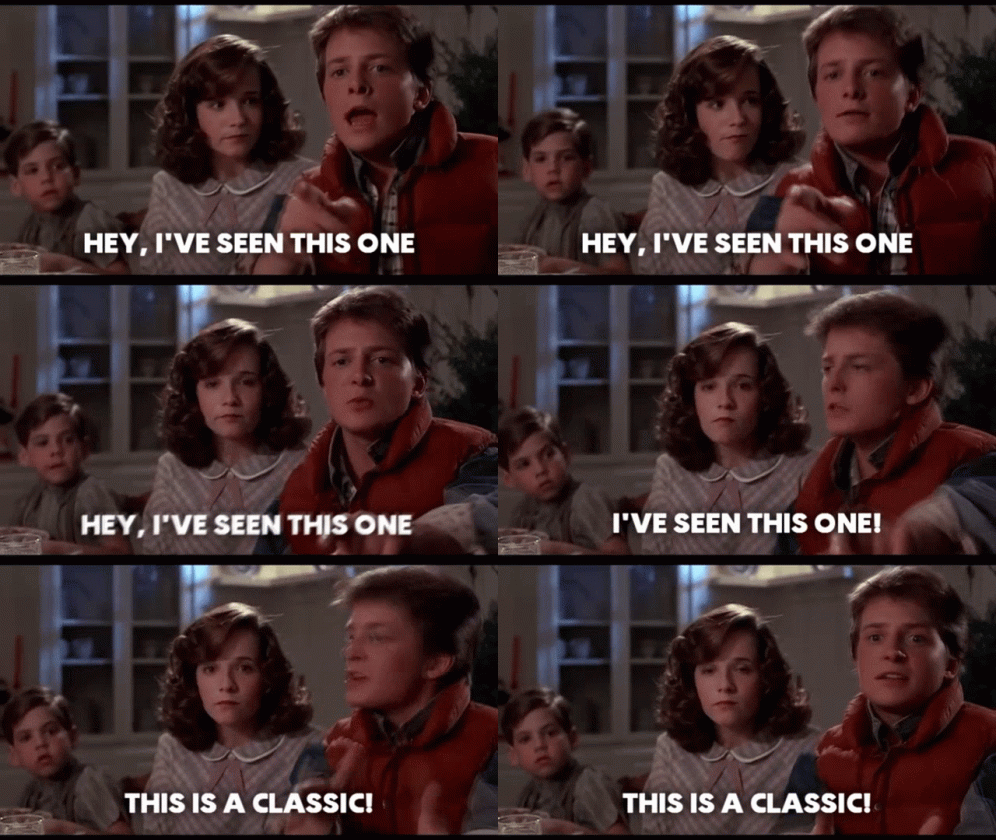
This October, I took my kids to see Back to the Future in theaters
for its 40th anniversary.
My favorite movie.
The one I have watched so many times that my brain can quote it
before the characters do.
Sitting there, watching their faces in the darkened theater react
to the DeLorean like it was a real animal, I felt something I do
not always let myself feel in the middle of a busy life.
Gratitude.
The kind that lands in your chest, not your head.
And honestly, the best part was sharing it with my people.
My lovely wife, who somehow keeps the whole ship moving even when
the sea gets rough.
And my lovely kids, who can turn a theater seat into a jumpy
launchpad and a living room into a sticky battle arena, sometimes
in the same hour, but who also make me feel that strange, fierce
kind of gratitude that has nothing to do with ease and everything
to do with love.
And then, because life has timing, Christmas Eve happened.
Screaming and not listening.
Rejecting the dinner I made like tiny food critics.
Staying up late.
Waking me up at night.
Then early.
Then again.
And by morning I could feel myself hardening, which is always my
warning sign that I need space, not another read on patience.
That is when I remembered what I teach trainees in ICU medicine.
Zoom in.
Zoom out.
Zoom in: I can be exhausted.
Zoom out: This is a great life. And I LOVE all of it.
And if I want to feel that goodness instead of just surviving it,
I need to practice gratitude like it is a skill, not a mood.
One quick segue, before we get practical.
Recently I found myself deliberately and pleasantly stuck down a
YouTube rabbit hole, watching John Mayer talk about wristwatches.
What struck me was not the price tags or how impressive his level
of detailed attention to the dials was.
No, it was the tenderness.
It was how real he got about it.
The way he speaks about a watch is the way some people speak about
a song, as if craftsmanship is a form of memory and a good object
can hold a piece of your life without asking permission.
It was really poetic.
That is what I want more of in 2026.
Not more stuff.
But more attention, the kind that actually lands on the people in
front of me instead of scattering across screens.
More reverence, meaning I want to treat ordinary moments like they
matter, because they do, and because they do not come back.
More moments that feel like they belong to me.
Inside Boka’s Notes: Personal, Professional, Polymath
1 The metric most people optimize backwards
2 Copenhagen 1952 to 1953 and the birth of the ICU
3 Art as an intervention, not a hobby
4 Four books that quietly rewired my year
5 Two years of monthly challenges and what they did to my mind
6 Two calendars, one life, and how to stop losing it
7 The planner as an instrument of gratitude
1 The metric most people optimize backwards
Most of us measure output because it is easy.
Shifts.
Lists. Ask my buddy Manzo on this one.
Emails.
Boxes checked.
But the quality of your life is mostly determined by something
harder to measure.
Capacity.
Capacity is what you have left when your kids are loud, your sleep
is broken, and someone needs you while you are out of you.
Over the Christmas holiday block, I opened my Hobonichi and
reviewed my entire 2025.
Page after page of real life.
Not curated.
Just recorded.
And what I saw was simple.
The days I felt the most grateful were not the days I accomplished
the most, necessarily.
They were the days I had space.
Question I wrote in the margin:
What am I doing that makes tomorrow harder for no good reason?
If you answer that honestly, you will find at least one thing to
release.
That is not quitting.
That is wisdom.
2 Copenhagen 1952 to 1953 the ICU was born from attention
In Copenhagen during the polio epidemic, patients were dying from
respiratory failure faster than hospitals could support them.
There were not enough iron lungs to go around.
There were too many people who simply could not breathe.
An anesthesiologist named Bjørn Ibsen pushed a radical approach.
Tracheostomy combined with positive pressure ventilation.
Oh, and relentless bedside support.
Mortality dropped dramatically.
And a new concept emerged: put the sickest patients together and
watch continuously.
Yes, Dr Ibsen founded intensive care medicine as we understand it.
The breakthrough was not a miracle drug.
It was attention.
Watching became an intervention.
That is my quiet link to gratitude.
Most people are not ungrateful.
They are overstimulated.
They (we) move too fast to notice what is already good.
3 Art as an intervention attention training disguised as play
When my house is loud, art is not a cute hobby.
It is a pressure release valve.
Drawing brings my attention back to me.
It makes me less reactive and more human.
Which is honestly a great goal for a grown man with a mortgage and
two children who can smell inconsistency like sharks.
Try in the new year to draw without posting.
Not the incurable need to post and perform.
Time to keep one drawing notebook unshared.
Keep one for my exhales.
4 Four books that quietly rewired my year
Part of 2025’s monthly challenges were to read more.
These are not reviews by any means, just thoughts.
The Courage to Be Disliked by Ichiro Kishimi and Fumitake Koga
Incredible actually.
Stop living for approval.
Start living by values.
Freedom begins when you stop negotiating your life with people who
are not living it.
Ender’s Game by Orson Scott Card
When you are capable, the hard stuff finds your hands.
Gratitude includes boundaries so you do not become the default
wastebasket for everyone else’s chaos.
The Essential Wooden by John Wooden and Steve Jamison
Standards create peace.
Do the next right thing.
Not the perfect thing.
Respect yourself so you can respect the team.
The Daily Dad by Ryan Holiday
I started it consistently in the summer.
I have bought it as gifts for new and current fathers.
It is my daily go to.
It kept reminding me that my kids do not need my CV.
They need my presence.
Hardcover only on this one.
5 Two years of monthly challenges small containers that create space
For the past two years I have run monthly challenges.
I trust them more than motivation because they are contained.
They appeal to my unit based attention span.
Thirty days off Instagram.
My mind got quieter.
My attention stopped being rented out.
Drawing daily for thirty days.
Ten minutes became medicine.
Calorie counting.
Not punishment but awareness.
Consistency for self respect.
Switching from Audible back to physical books.
Depth returned.
Reading makes you stay with a thought until it finishes.
The lesson is not perfection but presence. You cannot be grateful for a life you are never present for.
6 Two calendars Outlook for appointments, Hobonichi for life
I stopped trying to run a human life out of an appointment system.
Notion, Evernote, ToDo, Wunderlist, remember that one?
Too many systems, all digital, all competing for your attention.
Outlook is for where to be.
That is for the P in Professional.
Meetings.
Shifts.
Pickups.
Hobonichi is for who I am becoming.
It is where I write one line of gratitude.
One analog priority.
One small act that makes tomorrow easier.
And I filter it through my 3 Ps.
Personal.
Professional.
Polymath.
If one gets neglected, the other two get noisy.
7 The planner as an instrument of gratitude
My life gets better when I write things down.
Not because paper is magic.
Well, actually, Hobonichi’s paper is Tomoe River magic, but I
digress…
It might reflect the creative in me.
Because writing slows me down enough to tell the truth.
If you have not seen it, I wrote about gratitude and planning in my
Thanksgiving planner post.
Doctor’s Order
Here is the ending I want for this year, and maybe for the version
of me that sometimes forgets he is allowed to be human.
In 2026, I want more space.
Not empty space, but
Dedicated space.
Sacred space.
The kind where my wife gets the best of me.
My kids get a dad who repairs quickly.
My body gets sleep and strength instead of leftovers.
My mind gets reading time again, real reading, quiet and deep.
My hands get ink.
So I am going to do what has worked for the past five years of
journaling: build the year one Tuesday at a time.
Outlook keeps the wheels turning.
Hobonichi keeps me honest about where I am headed.
One line of gratitude.
One real priority.
One small act that makes tomorrow easier.
Then I am going to protect that space like it is oxygen.
We are not time traveling.
We are not waiting for motivation.
We are building the year on purpose.
SAnd if I learned anything watching that DeLorean with my kids,
it’s this:
Time is the only thing you cannot earn back.
So in 2026 I’m choosing space, attention, and the people I love,
on purpose.
Where we’re going, we need more time.
-Boka
This lives on BokaMD.com. If you want to read the next one, Substack is the easiest way to follow along:
https://bokamd.substack.com
Of course, this post is public. If it helped you exhale a little, feel free to
share it.